
Blog Topics
When winter shows up, your trees stop pretending. No leaves, no camouflage – just their real structure on full display. And for a lot of homeowners, you start noticing things you didn’t see all year.
That’s exactly why winter is the smartest time for a tree risk assessment. It gives arborists a clear look at issues long before storms, wind, or ice push things past the breaking point.
Key Takeaways
- Winter offers the clearest view of a tree’s structure, making it the best season for accurate risk assessments.
- Cold weather, bare canopies, and winter storms reveal hidden weaknesses that aren’t visible during the growing season.
- A winter assessment helps homeowners avoid costly emergency removals by identifying hazards before severe weather hits.
- Certified Arborists use standardized TRAQ methods and detailed documentation to give you accurate risk ratings and liability protection.
- Winter assessments provide a roadmap for scheduling pruning, removals, and monitoring during the safest and most effective seasonal windows.

Certified Arborists will explain any structural issues with your trees and provide recommendations on how to correct the problem.
Why Winter Is the Best Time for a Tree Risk Assessment
Tree experts know that winter is an ideal time for checking tree safety. During winter, Northern Virginia trees enter dormancy, where they lose their leaves and conserve energy. This creates perfect conditions for professional tree risk assessment.
Winter tree checks have several advantages you don’t get during other seasons. With full leaf drop complete, you can see the whole tree shape clearly. Structural problems, like weak branch attachments, competing trunks, and bark inclusions, become obvious to trained eyes.
“Winter assessments give us the clearest picture of a tree’s actual condition. When you can see every branch and evaluate the entire tree structure, you’re able to identify risks that would be completely hidden during the growing season.” – Logan Jones, ISA Certified Arborist at Riverbend Tree Service
How Winter Weather Reveals Hidden Tree Problems
Winter conditions expose structural issues that stay hidden during the growing season. Some key stressors include:
- Freeze–thaw cycles that cause cracks in weakened branches and trunks.
- Cold snaps that highlight trees with poor vitality or hidden decay.
- Bare canopies that make dead limbs, structural defects, and internal rot easier to spot.
- Snow and ice loading that add weight to already stressed or overextended branches.
- Seasonal winds that reveal weak attachments, splitting limbs, or unstable root systems.
Because these stressors “test” a tree’s structure, winter assessments give arborists a clearer picture of underlying problems. Evaluating trees before major weather events allows homeowners to address risks proactively rather than dealing with storm-related emergencies.
PRO TIP: Understanding frost cracks in trees helps property owners recognize winter damage that could make trees unsafe.
Can Winter Tree Risk Assessments Save You?
Winter assessments can save you money by preventing emergency tree situations. Emergency tree removal during storms can cost much more than planned removal during calm weather. When you identify hazardous trees before they are tested by Mother Nature, you can schedule removal quickly on your own terms and avoid the inflated pricing, delays, and damage that come with emergency calls.
How Winter Evaluations Help You Stay Ahead of Permit Delays
Local jurisdictions, like Fairfax County, may require permits for certain tree removal projects, and a winter assessment provides the documentation needed to support those applications. Starting the process early also allows you to complete any preventive tree removal before spring permit backlogs begin and scheduling becomes more limited.
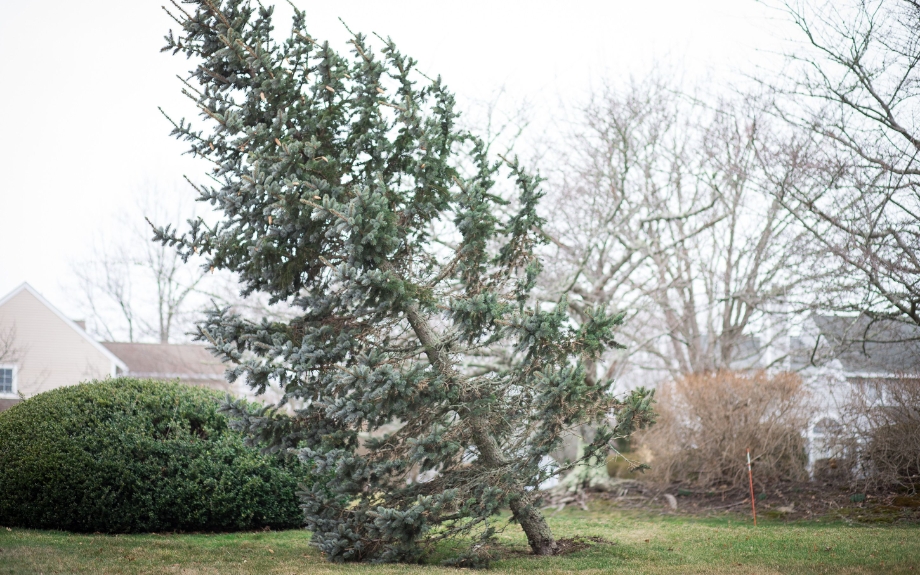
Winter assessments easily identify structural hazards like this leaning tree that could threaten property.
What You Get from a Professional Tree Risk Assessment
Tree experts with specialized training follow systematic evaluation methods during winter risk assessments. These complete inspections identify specific risk factors that could threaten property and personal safety.
A Detailed Look at Your Tree’s Structure
During a winter assessment, arborists examine:
- Branch structure and attachments, specifically weak unions, crossing limbs, and bark inclusions.
- Competing or co-dominant trunks, which are a major cause of splitting.
- Dead, dying, or cracked limbs that signal structural weakness.
- Trunk defects, such as cavities, cracks, and signs of internal decay.
- Root and base problems, including decay, heaving soil, and girdling roots.
With the canopy open and ground cover dormant, arborists can inspect the entire structure from the crown to the root flare without obstruction.
Accurate, Standardized Risk Ratings from TRAQ-Certified Arborists
Tree risk assessments evaluate three key factors:
- How likely the tree is to fail
- How likely it is to hit something important
- How severe the consequences would be
“Winter assessments let us apply professional methodology with the highest level of accuracy. When we can see the entire tree structure clearly, our risk ratings reflect the true condition of each tree. That precision helps property owners make informed decisions about their trees and their safety.” – Peter Hart, TRAQ-Certified Master Arborist at Riverbend
Documentation That Protects You and Your Property
Winter risk assessments provide complete documentation that supports property owner liability protection. Professional reports prepared by qualified arborists create records of responsible tree safety management.
PRO TIP: This documentation becomes particularly valuable for properties with mature trees near structures or property lines. Insurance companies recognize professional risk assessments as evidence of responsible property management. This can be crucial if tree failure causes damage despite professional evaluation.
How to Use Your Winter Assessment to Plan Future Tree Care
A winter evaluation provides a clear roadmap for what to do next – from budgeting to scheduling seasonal services.
Budget and Prioritize Based on Risk Level
A professional risk assessment breaks recommended work into clear urgency levels so you know exactly what needs attention now and what can be planned for later. This makes budgeting simple and keeps your tree care manageable:
- High-risk trees should be addressed right away, often through removal or urgent pruning during winter or early spring.
- Moderate-risk trees may only need targeted pruning, follow-up monitoring, or structural support.
- Low-risk trees can be maintained through routine care and scheduled into long-term planning.
This approach lets you tackle the most important safety issues first while preserving valuable trees through proper care.
Schedule Tree Work During the Best Seasonal Windows
A winter tree risk assessment helps you understand which trees pose safety concerns and when to schedule recommended work for the best results. Once you know a tree’s risk level, you can plan the timing of any follow-up actions:
- Pruning: Winter is the best time for pruning. With leaves gone, arborists can clearly see weak or hazardous limbs, and dormant trees respond better to pruning cuts. If a winter assessment identifies risky branches, they can be pruned before storms increase the chance of failure.
- Tree Removal: If a tree is deemed high-risk, winter provides the safest and most efficient window for removal. Equipment access is typically better before spring rains soften the ground, and addressing hazards early helps prevent storm-related emergencies.
- Monitoring: Not every concern requires immediate action. A risk assessment may categorize some trees as moderate-risk, meaning they can be monitored through the year. Winter establishes a baseline so the arborist can track changes over time.
Frequently Asked Questions About Winter Tree Risk Assessments
Why is winter better than fall for tree risk assessments?
Winter provides full winter dormancy conditions that aren’t present during fall months, when many trees still have leaves or are still transitioning into winter dormancy. Complete leaf drop allows for thorough structural evaluation.
What happens if urgent safety issues are discovered during winter assessment?
Qualified tree experts classify urgent risks that require immediate attention regardless of season. Emergency tree removal services can address immediate hazards even during winter months to protect property and personal safety.
How often should properties receive professional risk assessments?
Professional tree experts typically recommend annual assessments for high-risk trees and every 2-3 years for healthy mature trees. Properties with large, valuable trees benefit from annual assessments to monitor condition changes.
Do different neighborhoods in Northern Virginia have varying assessment needs?
Yes. For example, properties in Great Falls and McLean have mature forest settings that require different assessment approaches than suburban properties in Fairfax Station or Sterling. Arborists adjust evaluation methods based on local tree populations and risk factors.

Riverbend’s ISA Certified Arborists provide professional documentation and expert analysis during winter assessments.
Want Peace of Mind This Winter? Start with a Tree Risk Assessment from Riverbend
Winter provides the best timing for a complete tree risk assessment in Northern Virginia’s unique climate. Don’t wait until the spring growing season begins to evaluate your property’s tree safety.
At Riverbend Tree Service, our ISA Certified Arborists and qualified team members bring specialized expertise to every winter assessment throughout Fairfax, Loudoun, Montgomery Counties, and Washington, DC.
Call Riverbend Tree Service today at 703-402-9366 or request an estimate online to schedule a tree risk assessment. Our Certified Arborists are ready to help you make informed decisions about your trees’ safety and your property’s protection.

Give Us a Call at 703-402-9366
If you'd like help with your trees or landscape, have any questions, or would like to schedule an appointment with one of our Certified Arborists, please give us a call. We'd love to hear from you!


Other Articles on Our Blog