
Blog Topics
Early summer in Great Falls means your mature oaks and maples could face six invasive tree pests that work silently—often invisible until damage becomes severe. Most homeowners don’t realize the threat until a tree starts wilting in July heat or drops branches without warning. By then, the treatment window has often closed.
Destructive insects threaten Great Falls’ landscapes by working inside bark and foliage long before visible symptoms appear. Understanding which pests are active now, what damage they cause, and when intervention is critical can mean the difference between saving a tree and losing a landscape asset worth thousands of dollars.
Key Takeaways
- Six invasive pests target Great Falls’ trees—ambrosia beetles, spider mites, spotted lanternfly, leaf-eating caterpillars, scale insects, and aphids.
- Early summer is critical for detecting damage and preventing outbreaks before summer heat fuels reproduction.
- Each pest has a narrow seasonal window when treatment is effective; missing it means waiting until next year.
- Professional tree health management protects landscape investments worth 10–15% of property value.
Why Is Early Identification Important for Tree Pests?
The earlier a tree pest is identified, the more treatment options are typically available. Waiting until symptoms become obvious can make managing an infestation much more difficult for several reasons:
- Treatment windows are often short. Many insect pests are most effectively treated during specific stages of their life cycle.
- Damage continues over time. As insects feed or tunnel through the tree, they weaken its ability to transport water and nutrients.
- Symptoms often appear late. By the time you notice browning leaves, branch dieback, or exit holes, the infestation may already be well established.
- Different pests require different treatments. Correct identification helps ensure the right treatment is applied at the right time.
If you notice anything suspicious, contact an ISA Certified Arborist. Correct identification is the first step toward protecting your tree and applying the right treatment at the right time.

Ambrosia beetles are tiny invasive pests that bore into trees and introduce fungal pathogens, disrupting water and nutrient movement. Their activity often goes unnoticed until trees begin to wilt or decline.
1. Ambrosia Beetles
Ambrosia beetles kill stressed trees in a single season by spreading fungus through the vascular system and blocking nutrient flow.
How to Identify Ambrosia Beetle
Toothpick-sized frass tubes protruding from bark are the most obvious sign, along with sawdust-like piles at the tree base. They target thin-barked species, including dogwood, redbud, maple, ornamental cherry, and crape myrtle.
Signs of Ambrosia Beetle Damage
- Crown wilting in hot weather
- Branch dieback and thinning canopy
- Visible frass tubes and sawdust accumulation
When Ambrosia Beetles Are Most Active
The first generation peaks from April through June—the most damaging window. A second generation emerges in July. By the time wilting is visible, heavy infestation is already underway.
How to Manage Ambrosia Beetles
DIY treatment is ineffective once wilting is visible. If you spot frass tubes, contact a professional immediately. An arborist can assess whether preventive treatment or removal is needed.

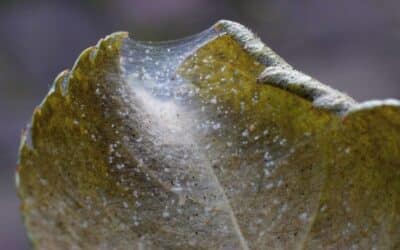
Spider mites are tiny arachnids that feed on leaf tissue, causing stippling, yellowing, bronzing, and premature leaf drop. Their populations can increase rapidly during hot, dry weather, making early detection essential for preventing widespread damage.
2. Spider Mites
Spider mites damage trees by piercing leaf tissue and sucking out plant fluids. During hot, dry weather, they can produce up to 20 generations per year, allowing populations to explode and strip leaves from entire branches in just a few weeks. They are not insects (they’re related to spiders and have eight legs), but they’re as destructive as other tree pests.
How to Identify Spider Mites
In northern Virginia, there are dozens of species of spider mites. The most common is the two-spotted spider mite, which is nearly invisible, measuring about 1/50th of an inch. You should identify them by the damage they cause rather than by sight.
Signs of Spider Mite Damage
- Stippled, yellowed, bronzed, or bleached leaves
- Damage on sun-exposed sides near pavement
- Fine webbing on affected leaves
- Defoliation and premature leaf drop
When Spider Mites Are Most Active
Spider mites overwinter as adults and become active as temperatures warm. The critical window for management runs from June through September.
How to Manage Spider Mites
Water sprays can help early infestations by knocking eggs and larvae off leaves. However, homeowners often worsen infestations by using conventional insecticides, which do not kill mites but eliminate their natural predators, like ladybugs and predatory mites, triggering population explosions. Professional miticide applications at the first sign of damage are far more effective.

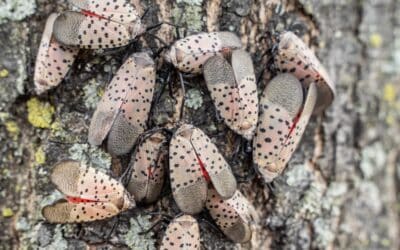
Spotted lanternflies feed on tree sap, weakening trees and leaving behind sticky honeydew that promotes black sooty mold growth. Their rapid spread across Northern Virginia makes early detection and management critical for protecting landscape trees.
3. Spotted Lanternfly
Spotted lanternfly weakens trees by feeding on sap, reducing their vigor and making them more vulnerable to drought, disease, and other stresses. Because it has no natural predators in North America and reproduces rapidly, populations can spread quickly across Great Falls’ landscapes.
How to Identify Spotted Lanternfly
Nymphs are active in early summer and appear black with distinctive white and red spots. Adults emerge in mid-summer through fall and appear gray with striking red hindwings. Both life stages feed on tree sap.
Signs of Spotted Lanternfly Damage
- Honeydew secretion (sticky residue) on leaves and branches
- Black sooty mold fungus from honeydew
- Wilting and stress on affected trees
When Spotted Lanternflies Are Most Active
Nymphs actively feed during early summer. Adult emergence occurs from July through September, bringing increased feeding pressure and reproduction. Great Falls is located in an active invasion zone based on recent detections in Loudoun County.
How to Manage Spotted Lanternflies
Mechanical removal of egg masses during fall and winter can reduce next year’s population. Scrape egg masses off trees and freeze or soak them in rubbing alcohol to kill them. However, manual removal alone cannot control larger populations. Professional summer and fall systemic treatments are far more effective.

Leaf-eating caterpillars can remove large amounts of foliage in a short period, weakening trees and making them more vulnerable to drought, disease, and other insect pests. Early intervention helps prevent extensive defoliation and long-term stress.
4. Leaf-Eating Caterpillars
Large populations of leaf-eating caterpillars can quickly strip a tree of its foliage, reducing its ability to produce energy and leaving it vulnerable to additional stresses. In Northern Virginia, homeowners most commonly encounter fall webworms, eastern tent caterpillars, and spongy moth caterpillars.
How to Identify Leaf-Eating Caterpillars
Eastern tent caterpillars and spongy moths create visible tents or webs at branch ends and forks. Fall webworms create similar webs but appear later in the season. All three species feed on oaks, maples, fruit trees, and many other deciduous species.
Signs of Damage
- Visible tents or webs at branch ends
- Obvious defoliation and exposed branches
- Leaf fragments visible on ground
When Leaf-Eating Caterpillars Are Most Active
Eastern tent caterpillars and spongy moths peak from March through May, with treatment windows closing by early June. Fall webworms have a different timing window, starting in late July and peaking in August through September.
How to Manage Leaf-Eating Caterpillars
Pruning visible tents and webs is an effective DIY control method when caterpillars are accessible. Remove affected branches entirely and destroy them. Spray timing is critical because it must happen before caterpillars retreat into webs where sprays cannot reach them. Professional monitoring and applications are far more effective, particularly for fall webworms requiring summer or early fall treatment.

Scale insects often blend into bark and branches, allowing infestations to go unnoticed until trees show dieback, yellowing foliage, or black sooty mold. Early detection is critical because treatment is most effective during the crawler stage.
5. Scale Insects
Scale insects remain nearly stationary on bark, making them invisible until damage is severe—yet they feed continuously on sap, eventually killing branches, trunks, and entire trees.
How to Identify Scale Insects
Armored scales appear as small, domed, waxy coverings measuring 1/4 to 1/2 inch on branches, twigs, and trunks. They often look more like tree damage than insects. San Jose scale and brown soft scale are the most destructive species found in Northern Virginia.
Signs of Scale Insect Damage
- Leaf, twig, and branch dieback
- Honeydew secretion on bark and foliage
- Black sooty mold fungus
When Scale Insects Are Most Active
The crawler stage, when newly hatched scales are mobile and vulnerable, is the only effective treatment window. This window occurs in spring as temperatures warm.
How to Manage Scale Insects
Dormant oil sprays applied in late winter or early spring before growth begins work by smothering overwintering pests and eggs. Do-it-yourself applications can be effective with diligent coverage. Heavy infestations detected in early summer may require waiting until next spring. A professional arborist can assess the severity and recommend whether treatment is possible now or should be scheduled for next year’s dormant season.

Aphids feed by extracting sap from leaves and new growth, causing curled foliage, stunted shoots, and tree stress. Their rapid reproduction allows populations to surge quickly, especially during spring and fall growth periods.
6. Aphids
Aphids may be tiny, but large populations can remove significant amounts of sap from developing leaves and shoots. Because females reproduce rapidly without mating, infestations can grow quickly, causing distorted growth, yellowing foliage, and stress that weakens trees over time.
How to Identify Aphids
Soft-bodied insects measuring about 0.1 inches long come in various colors including green, black, brown, red, or yellow. They often have waxy coatings and can be found clustered together on branches, stems, flower buds, and on the undersides of leaves.
Signs of Aphid Damage
- Deformed or twisted leaves
- Stunted growth on new shoots
- Yellowing foliage
- Sticky honeydew residue
- Black sooty mold fungus
When Aphids Are Most Active
Aphids remain active from spring through fall throughout Northern Virginia. They emerge in spring with warm temperatures and peak during spring growth from March through May. A second peak occurs during fall growth flushes. Populations can explode overnight under the right conditions, making early detection critical.
How to Manage Aphids
Natural controls, such as ladybugs, lacewings, parasitic wasps, and birds, are usually sufficient in mild years. In outbreak years, regular water sprays or applications of horticultural oil and neem oil sprays can help control early infestations. Professional monitoring throughout the season catches aphid outbreaks during early stages when they are most manageable. Arborists understand which natural predators to preserve and can apply targeted treatments if populations exceed what natural controls can handle.
When Should You Call a Professional Arborist?
Early-stage infestations are invisible without professional expertise. By the time damage becomes obvious, the treatment window has closed. Each pest has a specific biological window determined by temperature accumulation (Growing Degree Days), not calendar dates. A structured annual tree health management program catches each pest during vulnerable windows and is far more effective than one-time treatments.
Frequently Asked Questions About Destructive Tree Pests
Can I prevent these pests myself?
Basic monitoring and keeping trees healthy help, but prevention requires professional expertise. Early-stage infestations are invisible without magnification. Treatment timing is tied to temperature accumulation, not calendar dates.
If I see frass tubes on a tree, is it too late?
Not necessarily. Frass tubes indicate active ambrosia beetle activity. If infestation is light and the tree is healthy, preventive treatment may work. Heavy infestations may require removal. Professional evaluation determines the best option.
Do I need to remove a tree infested with spotted lanternfly?
Not always. Light infestations can be managed with summer and fall systemic treatments or egg mass scraping. Heavy infestations on weak trees may warrant removal. Professional evaluation determines whether the tree can be saved.
What’s the best time of year to start a tree health management program?
Early spring (March–April) is ideal because it aligns with the first treatment windows for dormant oils, preventive sprays, and early-season monitoring. However, starting in early summer still captures critical windows for spider mites, spotted lanternfly, and second-generation pests. The key is consistent year-round monitoring and treatment timing based on temperature accumulation, not calendar dates.
How often should I have my trees inspected for pest damage?
A comprehensive annual inspection in early spring is the baseline, followed by seasonal monitoring during peak pest activity windows (late spring through fall). High-value specimen trees or properties with a history of pest issues benefit from quarterly inspections. Early detection is critical—by the time damage becomes visible, treatment windows may have closed.

Many destructive tree pests remain hidden until damage becomes severe. A professional tree health assessment can identify early signs of insect activity, disease, and decline before treatment windows close and costly damage occurs.
Get Expert Help Identifying Tree Pests
The arborists at Riverbend Landscapes & Tree Service are available to examine your trees, identify the pest, disease, or other factors affecting your tree, and prescribe a treatment plan. Call us today at 703-402-9366 or request an estimate online.
Other Articles on Our Blog